New Hartford Historical Society
New Hartford, Connecticut
America’s 250th
CT’s Forgotten Declaration
State’s largely unknown proclamation was weeks ahead of official document by Jordan Nathaniel Fenster Staff Writer.
The Connecticut General Assembly had adjourned for the summer on June 8, 1776, when Gov. Jonathan Trumbull called the members back for a special session a week later. It was becoming ever clearer that the colonies were getting ready to become separate from England.
Trumbull called the assembly back into session on June 14, 1776, With the intention of following the example of Richard Henry Lee, Virginia’s representative to the Second Continental Congress, who drafted and published a formal resolution declaring, “that these united colonies are and of right ought to be free and independent states.”Trumbull and members of the assembly did just that, producing what the state library later called Connecticut’s “Proclamation on Independence,” three weeks before Thomas Jefferson’s now iconic declaration was adopted.
“They banged it out in a day,” said Matt Warshauer, a professor of history at Central Connecticut State University. The final document was sent to Philadelphia to Connecticut’s four delegates at the Continental Congress, instructing them to vote for independence from England.The document remains largely unknown and misunderstood, Warshauer said, with the few historians aware of its existence believing it is little more than instructions to the delegates, including Roger Sherman, who also served on the Committee of Five — the select group that helped Jefferson draft the declaration. But Connecticut’s proclamation “is definitely a declaration of independence,” Warshauer said. “Nobody knows this thing exists,” he said.
The two documents, Connecticut’s proclamation and Jefferson’s declaration, are similar in many ways, Warshauer said, suggesting that Jefferson did not write the Declaration of Independence from scratch but drew from a variety of sources for both language and structure.
Earlier that year, Thomas Paine had published “Common Sense” in response to the battles of Lexington and Concord, and Bunker Hill, writing, “Everything that is right or natural pleads for separation.” That document has also been referenced for inspiration on the Declaration of Independence.“The issues that Jefferson discussed and the language that he used was also used by Connecticut, which reveals that the language of liberty and the ideas in the Declaration had actually been around extensively for quite some time,” he said. “As a result of that, I’ve really come to the conclusion that Jefferson was more the scribe of the Declaration than its sole author.”
There is no sweeping opening statement in Connecticut’s proclamation, such as Jefferson wrote: “We hold these truths to be self-evident, that all men are created equal, that they are endowed by their creator with certain unalienable rights.”
But both documents follow the same progression, beginning with statements that Britain violated the colonists’ rights, mentioning the petitions that were rejected by the crown, which then used military force making reconciliation impossible. Both documents appeal to God and both conclude that independence is the only available remedy. Where Connecticut leaders wrote that Britain “refused to listen to their many and frequent humble decent and dutiful petitions for redress of grievances,” Jefferson wrote, “In every stage of these Oppressions We have Petitioned for Redress in the most humble terms.”
Connecticut’s proclamation declares that they are “out of the King’s protection.” Jefferson wrote that the king “has abdicated government here, by declaring us out of his protection.” Both documents refer to the use of “foreign mercenaries,” but where Connecticut says those mercenaries “destroy our towns” and “shed the blood of our countrymen,” the U.S. declaration says they, “burnt our towns, and destroyed the lives of our people.”The primary difference between the two documents is their relative perspective. Connecticut’s proclamation begins, “At a General Assembly of the governor and company of the English colony of Connecticut,” and argues that the king had violated their constitutional rights as British citizens. Jefferson’s declaration, however, argues that rights are derived from God, and that “Governments derive legitimacy from natural rights and consent, therefore the colonies are justified in creating new governments.”
“That they specifically defined Connecticut as an ‘English Colony’ could have no other meaning than to underscore the gravity of the statement they were making,” Warshauer wrote in a pamphlet.. “For the end of the document revealed without question that Connecticut would no longer be bound to England.”
Perspective on the reading of the Declaration of Independence
This year’s reading was conducted at spot where the New Hartford’s meeting house and church stood at the corner of Hoppen and Townhill Rd (Rt 219). The foundation and church bell still remain at this location.
250 years ago, the Declaration of Independence would have been read at this very spot.
Typically, a gathering such as this one would have been attended by free, property-owning adult males.
There would have been heated arguments arguing for and against supporting the declaration of independence.
Loyalists would have been arguing to remain with England.
- They were called Tories which was derogatory Irish term for outlaws or robbers
- Roughly 15% of the people in New England were Loyalist
- 25% of the people were neutral/undecided in 1776
In New Hartford, there were 1000 residents at that time, that would mean ~350 people who were not dedicated or against the separatist cause. Why?
- Economic Reasons (merchants who depended on trade to England)
- Clergy dedicated to the Anglican Church
- Fear! This was an Act of Treason against England
A few of the events preceding the Declaration of Independence:
- Sugar Act (1764), Stamp Act (1765), Quartering Act (1765), Townsend Act (1767)
- People were tired of having their money and resources pillaged for the benefit of the English Empire.
- 1770 Boston Massacre – tempers flared
- 1773 Boston Tea Party – ~340 chests, or 92,616 pounds, of tea dumped into Boston Harbor
- 1774 the Tea Party prompted the Intolerable Acts – punitive laws meant to punish Massachusetts
- 1775 Lexington/Concord
- The publication of Thomas Paine’s Common Sense in January 1776
- 1776: Continental Congressà Declaration of Independence
Because news moved slower, no phones, internet, newspapers were slow, it would have taken a few weeks for this reading to happen here.
Going to war if you are able bodied male, and/or sending your sons to fight against the crown’s forces. Mothers and daughters would be left behind to tend to the farm, animals, firewood, and supporting the war effort.
Imagine the atmosphere, the implications of the town’s reaction to hearing the Declaration read out loud.
Upcoming events
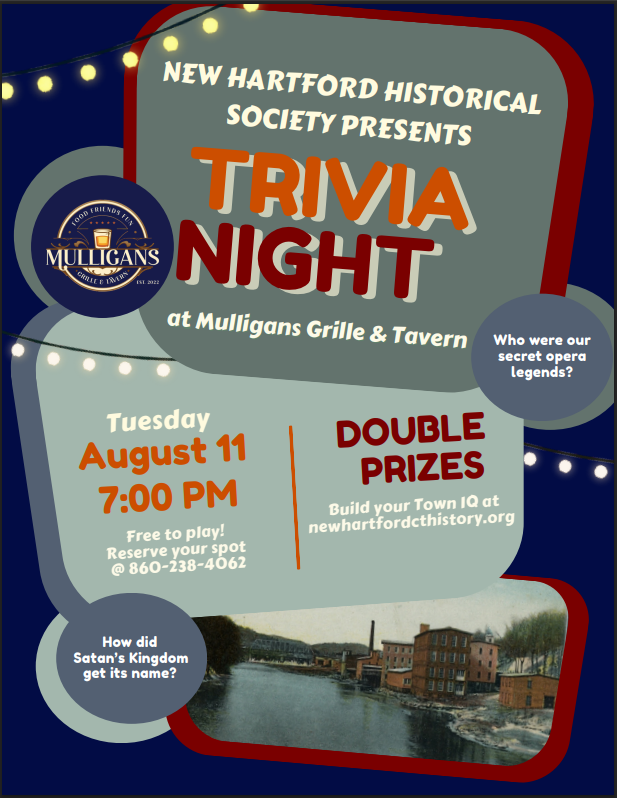
Join us for Trivia night at mulligans
Newsletter
Please see our latest newsletter!
History Open Invitation
As part of our initiatives for 2025 and moving forward, we are looking to capture our current history. Any notable events in town are open. NHHS will be capturing these current histories and documenting them for future reference. Please send important events to csihpol@newhartfordcthistory.org.
Along those same lines, if you have any past historical stories that should be documented, please feel free to contact us. We would be happy to receive these stories in any form you are comfortable; email, your own recording or we would be happy to record an interview. Please reach out to csihpol@newhartfordcthistory.org to arrange communication.
Come join us during our OFFICE HOURS:
First Wednesday of the month from 2-4pm, or 3rd Saturday of the month from 2-4pm
PAST EVENTS
Click here for more information.
Click here for River Rocks Website
Come visit our booth for some interesting items and information about the influence the River has had on our town.
The West Branch of the Farmington is a Partnership Wild and Scenic River, according to the National Park Service, and is a model that has been followed by other eastern rivers as they have put together management plans. Thousands of people canoe, kayak, and fish its waters, and visit the state parks, forests and mills that the river flows by. The river is an excellent habitat for wildlife as otters raise families along its banks and Atlantic salmon are soon expected to return to its waters after an absence of decades. The Farmington Valley is currently the only place in Connecticut with nesting bald eagles, which can be seen soaring above the river in search of the next meal for their nestlings.
If you would like to learn more about how the West Branch of the Farmington River became declared an official Wild and Scenic River, please see this history provided by the esteemed Ginny Worrest:

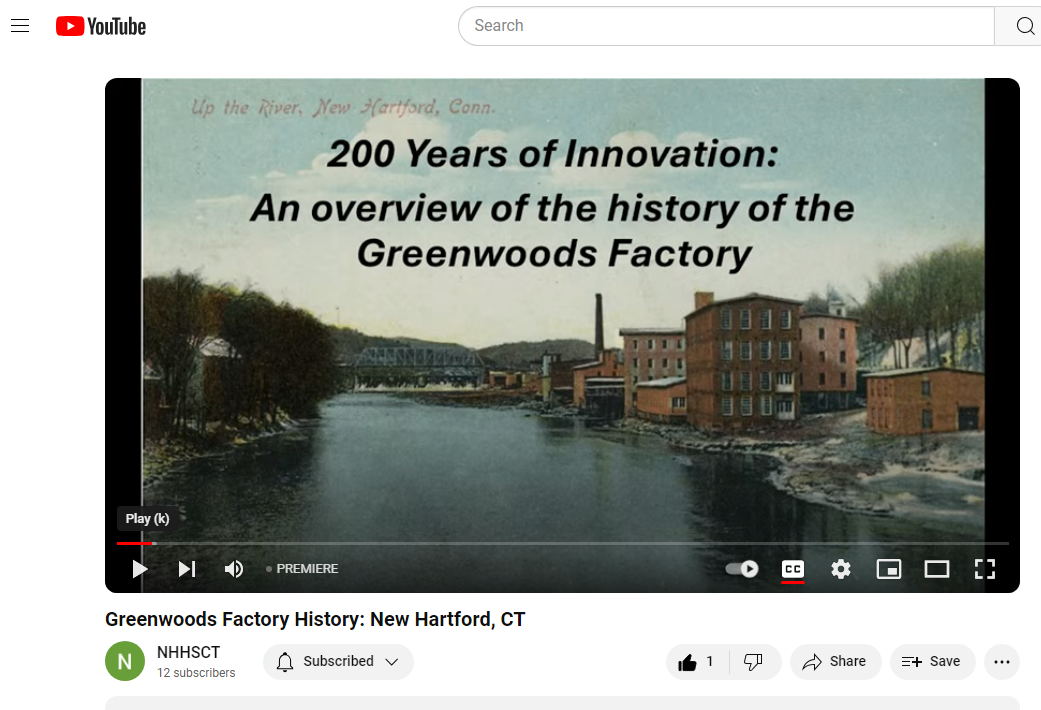
History of Greenwoods, Presented by Anne Hall, Town Historian and Secretary of NHHS
Click here to watch our YouTube video.
Please be sure to “like” and subscribe
Strayfields Town Park, Presented by Anne Bailey, Board Member
YouTube video link and PowerPoint download below:
Video of Presentation please “Like” and “Subscribe”
Founding of New Hartford, Presented by David Krimmel, Town Historian Emeritus.
Download the PowerPoint below. A link to the video is also provided.
Founding of New Hartford, CT PPT
Video of Presentation please “Like” and “Subscribe”
Trains of New Hartford, Presented by Anne Hall, Town Historian.
Watsons of New Hartford and Their Houses: 1734 to 1854. Presented by David Krimmel, Town Historian Emeritus.
Thanks to everyone for an awesome event on the Flood of ’55!
A View of 19th Century Brick Houses, Presented by David Krimmel, New Hartford town historian emeritus
Native Americans of Northwest Connecticut
The Prominent Women of New Hartford
We look forward to seeing you!

